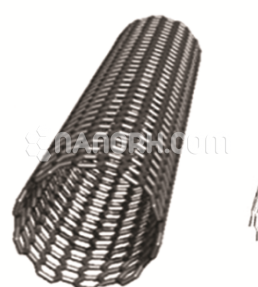
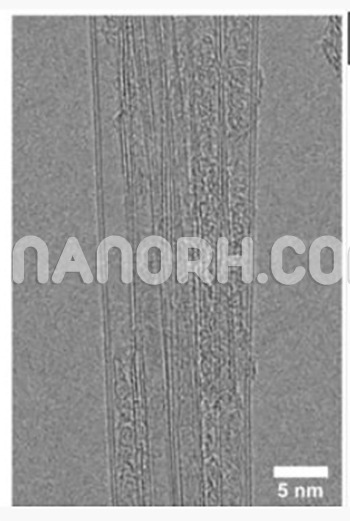
Boron Nitride Nanotubes Product No NRE-14003 CAS No. 10043-11-5 Formula BN Average diameter 30-50nm Average Length up to 200µm Purity 99.9% Molecular Weight 24.82 g/mol Density 1.9 to 2.1 g/cm3 Melting Point 2,973 °C Boiling Point Na Boron Nitride Nanotubes (BNNTs) is a nanoscale form of boron nitride with structure and properties similar to carbon nanotubes that make them ideal for use in solutions and semiconductor thin films with applications in optics, electronics, transistors, and energy storage. Applications The hexagonal bonding pattern of BNNTs gives them exceptional properties, including high thermal conductivity, mechanical strength, and electrical insulation. These properties make BNNTs a promising material for a wide range of applications, from electronics and energy storage to biomedicine and advanced materials. Structure and Properties of Boron Nitride Nanotubes (BNNTs) Boron Nitride Nanotubes can be thought of as hollow tubes made from boron nitride (BN) sheets, rolled into cylindrical structures. Their structure, similar to carbon nanotubes (CNTs), can be classified as single-walled (SWBNNTs) or multi-walled (MWBNNTs), depending on the number of concentric tubes stacked together. Crystal Structure: BNNTs are typically formed from hexagonal boron nitride (h-BN), which has the same structure as graphene but with alternating boron and nitrogen atoms instead of carbon. This gives BNNTs similar sp² hybridization bonding as CNTs, with a strong covalent bond between the atoms. Mechanical Properties: BNNTs are known for their exceptional mechanical strength, with tensile strengths reported to be comparable to or even surpassing that of carbon nanotubes. This makes them suitable for applications requiring lightweight, strong, and flexible materials. The elastic modulus of BNNTs is also very high, contributing to their durability and resilience in various mechanical environments. Thermal Properties: One of the key properties of BNNTs is their high thermal conductivity, which is comparable to that of graphene and much higher than most other materials. BNNTs can efficiently transfer heat, making them ideal for thermal management applications. BNNTs also have a high thermal stability and are capable of withstanding temperatures of up to 900°C in air, which makes them suitable for high-temperature applications in aerospace and electronic devices.